

The Classical Theory
The industrial revolution started in the eighteenth century in Great Britain management, called a classical theory. The classical theory got evolved at the outset of the twentieth century. The classical theory comprises two different outlooks. They are; (i) scientific management and (ii) administrative management. The management practitioners of the twentieth century like F.W. Taylor, Henry Fayol, and Max Weber attempted to combine theory with practice and thus the above-mentioned two different points of view came forth.
(i) Scientific Management
The theory that helps to improve the productivity of labour and management through scientific research, analysis, and application of standard rules and principles is called scientific management. The scientific management includes the major innovations of F. W. Taylor, Frank and Lillian Gilbreth, Henry L. Gantt, William H. Leffingwell, and Harrington Emerson. The core of scientific management knows exactly what you want men to do and seeing that they do it in the best and cheapest way. The following part deals with the contributions of management experts of the scientific management era.
F.W. Taylor (1856-1915)
Frederick Winslow Taylor is esteemed as the father of scientific management. Taylor discovered the cerebral approach to solve organizational problems like degrading efficiency and rationale of workers and contributed to developing management as a science and profession. He initially served as a machinist (foreman) in Midvale Steel Company, Philadelphia. His experiments on time and motion study of workers helped improve the individual performance of the company’s workers by setting standards for efficient working. Later he also introduced a differential payment system that satisfied and motivated efficient workers. After he earned a degree in engineering he invented high- speed steel- cutting tools and worked as a consultant for companies like Simonds Rolling Machine Company, Bethlehem Steel, and others.
Further, he continued his experiments and introduced the elements of designing jobs, scientific ways of recruiting and training workers, and reorganization of supervision. He compiled his innovations on Shop Management (1903) and Testimony before the Special House Committee (1912). He also published the first book on management called ‘Principles of Scientific Management’ (1911). In his career course of 26 years, he endeavored to develop a science for each element of the job to replace the old rule of thumb methods.
Principles of Scientific Management
To enhance the productivity of workers and management Taylor has suggested some guidelines, which we call the principles of scientific management. The values or main beliefs or maxim of scientific management developed by F.W. Taylor is called principles of scientific management.
Bethlehem steel is still practicing all the same major principles of scientific management and considered one of the first organizations to benefit from the theory.
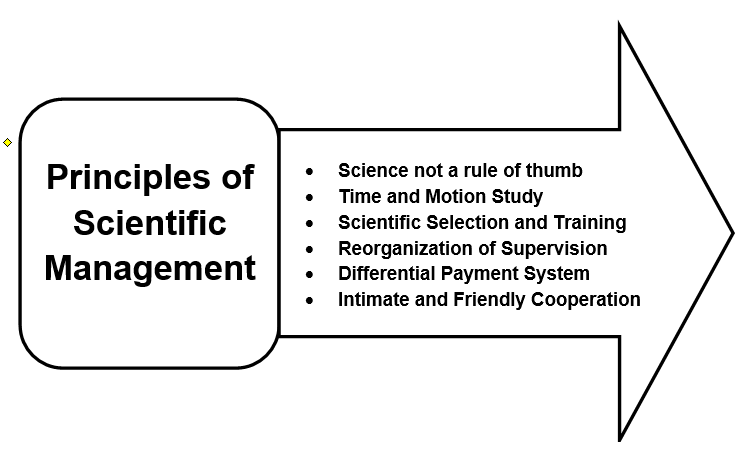
1. Science not a rule of thumb
This principle indicates that the management of work, processes, tools, and workers should be undertaken scientifically. It should not be based on impression, beliefs, and judgment, which is called a rule of thumb.
2. Time and motion study
This principle specifies that certain standards should be ascertained by studying the time, tasks, and motion of workers. Added to this, Taylor has signified designing the most efficient way of doing each part of the overall tasks. This helps to set and to achieve efficiency in an organization.
3. Scientific selection and training
This principle implies the scientific selection and training of workers and then assigns each individual the earlier specified standard of work. This helps to improve the performance of individual workers.
4. Reorganization of supervision
The principle denotes the foreman should design the work and not the workers. This is called division of planning. In addition, each foreman on the basis of his specialization should suggest the tools and sequence of operations to the workers. This is called functional foremanship.
5. Differential payment system
The workers producing more output is to be rewarded more if he surpasses the standard and the workers producing the standard pieces in the identical time is to be paid low piece rate. This is called a differential payment system. This helps to motivate workers.
6. Intimate and friendly cooperation
This principle denotes maintaining healthy relationships between managers and workers so as to build a common interest between themselves.
Frank Gilbreth and Lillian Gilbreth (1868- 1924 and 1878-1972)
Frank Gilbreth and Lillian Gilbreth, the husband and wife team are remarkably known for contributing to scientific management. Frank is known primarily for his time and motion studies. He studied the bricklayers at work and experimented with developing a procedure to increase job efficiency. He succeeded in reducing the number of physical movements from eighteen to two and increased output by almost 200 percent. Lillian Gilbreth is esteemed as the ‘first lady of management.’ Lillian, an industrial psychologist, showed her concern for human aspects and helped shape personnel management. Gilbreths worked together and individually as well and developed various methods and measures of increasing efficiency. Gilbreths also invented michronometer for recording the motions of workers and studying the deal of time spent on each physical movement.
Henry L. Gantt (1861- 1919)
Henry L. Gantt, a mechanical engineer, conceived some other techniques for improving worker output. He was an associate of F. W. Taylor in all three companies Midvale Steel Co., Simonds Rolling Machine Co., and Bethlehem Steel. He keyed the significance of personnel elements in plants and productivity and evoked the concept of motivation. He also developed the ‘Gantt Chart’ for enhancing controlling and scheduling activities in complicated projects and programs. Besides he also polished Taylor’s incentive scheme by introducing a bonus system to overproduction and strongly advocated scientific management.
William H. Leffingwell (1864- 1932)
William H. Leffingwell is reputed as the father of office management. He was trained as a stenographer and practiced the principles of scientific management in office work. His book ‘Scientific Office Management was published in 1917 A.D. Moreover he formulated five principles of effective work and proper management of the office. They are; planning, scheduling, executing, measuring, and rewarding.
Harrington Emerson (1853- 1931)
Harrington, an engineer, published a book named ‘Twelve Principles of Efficiency’ in 1911. He presented seven principles of systems of management and five principles of employer-employee relations in his book. He served several companies in the USA for cost savings in day-to-day operations. He also potently urged specialized management roles in organizations. In addition, he laid a broader focus on the organization structure and its importance and emphasized the use of experts in the organization.
Contributions of Scientific Management
At the first base, the scientific management movement added vitality to US companies and the economy. In later days many organizations, around the globe, assessed manifold gains by applying the principles of scientific management.
The major contributions of scientific management are as presented below;
1. It helps to increase productivity through greater efficiency in production and scientific increase in the pay system.
2. It helps to maintain a harmonious relationship between workers and management.
3. It also focuses on developing the competencies of workers through training and development.
4. It helps improving work culture and working conditions by redesigning work and tools.
5. It’s a foundation for the development of management theories like; human relations theory, systems theory, management science theory, etc.
Limitations of Scientific Management
Although it is accepted that scientific management enables the management to put resources to its best possible use and manner, yet it has not been spared of severe criticism. The limitations of scientific management are as mentioned below:
1. Workers feel that management reduces employment opportunities from them through the replacement of men by machines and by increasing human productivity fewer workers are needed to do work leading to chucking out from their jobs.
2. Workers feel they are exploited as they are not given due share in increasing profits which is due to their increased productivity. Wage payment creates uncertainty & insecurity (beyond a standard output, there is no increase in wage rate).
3. The scientific management lays standard output, time so the workers have to rush up and finish the work in. time. These have an adverse effect on the health of workers.
4. Scientific management is a costly system and a huge investment is required in the establishment of planning, standardization, work-study, training of workers. It may be beyond the reach of small firms.
5. Scientific management requires mental revision and complete reorganizing of the organization. A lot of time is required for work, study, standardization & specialization. During this overhauling of the organization, the work suffers.



The information shared is of top quality which has to get appreciated at all levels. Well done…
Thank you for sharing indeed great looking !
A great post without any doubt.
The information shared is of top quality which has to get appreciated at all levels. Well done…
The information shared is of top quality which has to get appreciated at all levels. Well done…
Thank you so much for sharing this wonderful post with us.
The information shared is of top quality which has to get appreciated at all levels. Well done…
Thank you so much for sharing this wonderful post with us.
Nice i really enjoyed reading your blogs. Keep on posting. Thanks
The information shared is of top quality which has to get appreciated at all levels. Well done…
A great post without any doubt.
Thank you so much for sharing this wonderful post with us.
Thank you so much for sharing this wonderful post with us.
Nice i really enjoyed reading your blogs. Keep on posting. Thanks
Thank you for sharing indeed great looking !
Nice i really enjoyed reading your blogs. Keep on posting. Thanks
A great post without any doubt.
A great post without any doubt.
The information shared is of top quality which has to get appreciated at all levels. Well done…
Thank you so much for sharing this wonderful post with us.
A great post without any doubt.
Nice i really enjoyed reading your blogs. Keep on posting. Thanks
Thank you so much for sharing this wonderful post with us.
A great post without any doubt.
Thank you for sharing indeed great looking !
Thank you so much for sharing this wonderful post with us.
A great post without any doubt.
The information shared is of top quality which has to get appreciated at all levels. Well done…
Thanks for another informative website. Where else could I get that type of info written in such a perfect way? I’ve a project that I am just now working on, and I have been on the look out for such information.
Nice i really enjoyed reading your blogs. Keep on posting. Thanks
We stumbled over here coming from a different page and thought I might as well check things out. I like what I see so now i am following you. Look forward to checking out your web page again.
Thank you so much for sharing this wonderful post with us.
I’m pretty pleased to uncover this site. I want to to thank you for ones time just for this fantastic read!! I definitely savored every part of it and i also have you book marked to check out new information on your site.
Oh my goodness! Awesome article dude! Many thanks, However I am encountering problems with your RSS. I don’t understand the reason why I can’t subscribe to it. Is there anybody else getting similar RSS issues? Anyone who knows the solution can you kindly respond? Thanks!!
Nice i really enjoyed reading your blogs. Keep on posting. Thanks
I’ve discovered a treasure trove of knowledge in your blog. Your unwavering dedication to offering trustworthy information is truly commendable. Each visit leaves me more enlightened, and I deeply appreciate your consistent reliability.
I must commend your talent for simplifying complex topics. Your ability to convey intricate ideas in such a relatable way is admirable. You’ve made learning enjoyable and accessible for many, and I appreciate that.
I love how clearly you explained everything.
Love how it supports Fantom and BSC out of the box.
The best way to explore low-cost DeFi tools.
Really helped me rethink how I provide liquidity in DeFi.
I’m extremely impressed with your writing skills and also with
the layout on your blog. Is this a paid theme or
did you customize it yourself? Either way keep up the excellent quality writing, it’s rare to see a great blog like this
one nowadays.
These are actually enormous ideas in concerning blogging.
You have touched some pleasant factors here. Any way keep
up wrinting.
I used to be able to find good info from your blog posts.
Trusted platform in Canada.
Fantastic experience every time.